Developer Hiring in the AI Era: Fluency Over Raw Coding
Have hiring standards really changed in the AI era, and what shifted

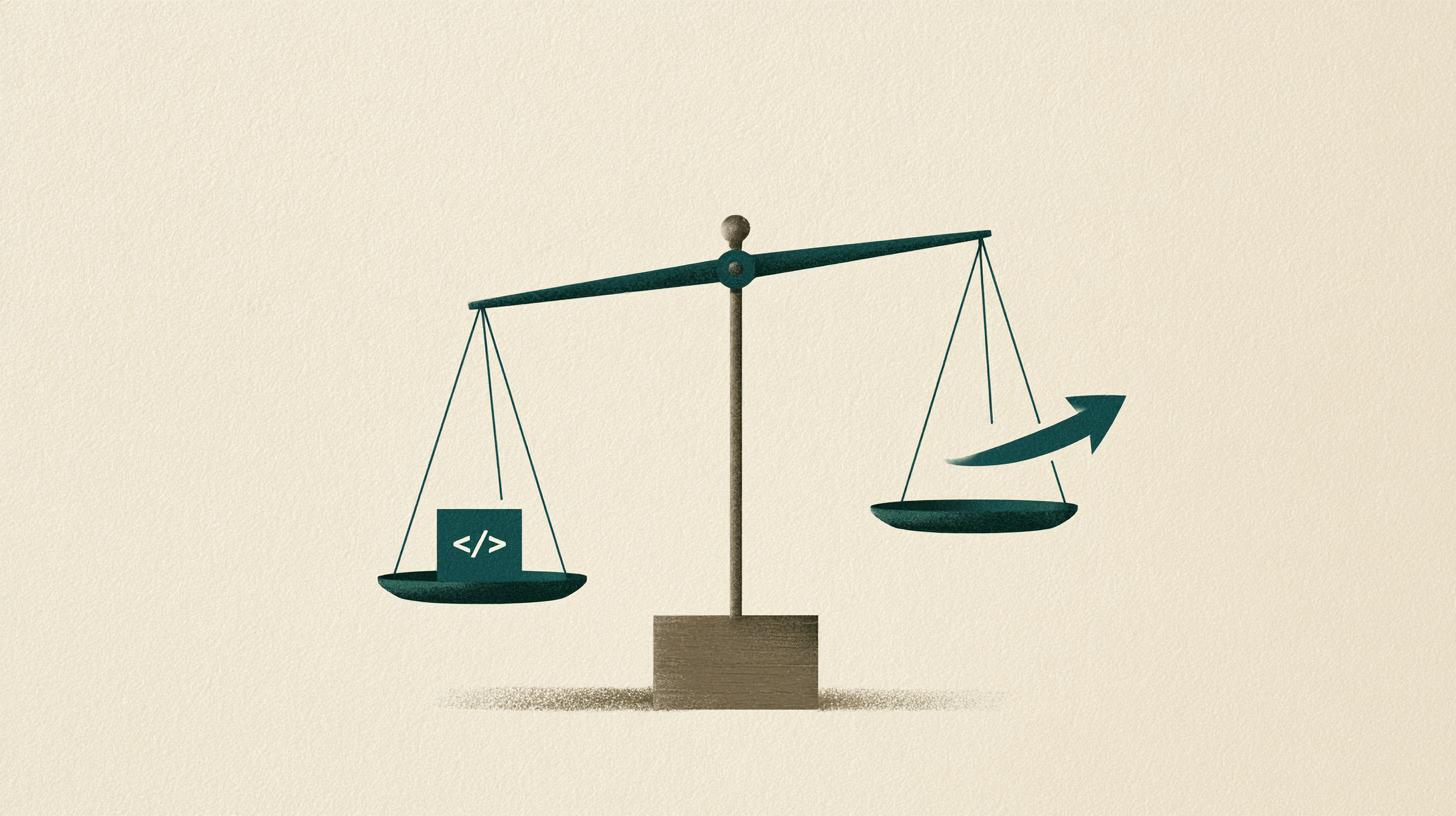
Yes, they have shifted in a real way. Employers used to measure developers by algorithmic depth, the volume of code they could write, and the thickness of their framework experience. What decides the outcome now is the ability to work alongside AI: knowing how to delegate to tools, how to verify the results, and how to keep process discipline. Pure coding skill still matters, but it is no longer the most important sorting variable.
The change does not mean developers no longer need to know how to code. Someone who cannot follow the logic, cannot read the code an AI produces, and cannot catch a subtle bug is still useless, and arguably more dangerous because they trust blindly. What changed is the proportion. Across a working day, the slice of time a developer spends typing every line by hand has shrunk, while the slice spent defining the problem, instructing the tool precisely, and re-reading and fixing the output has grown.
Here is a simple way to picture it. The best person used to be the one who typed fast and remembered a lot. The best person now is the one who knows how to ask the right question, describe the context accurately, and doubt in the right places. Someone slow with AI can still finish the work, but someone fluent with AI finishes the same volume several times faster and with steadier quality. That gap is wide enough to redraw the entire order of priorities in hiring.
For a company building a technical team, the implication is clear. If you still grade candidates mainly by hard algorithm scores or years on a specific language, you are filtering for the wrong thing. You may hire someone who looks strong on paper but is slow and rigid in a real environment, while overlooking someone with only adequate fundamentals who learns tools at remarkable speed and produces far more.
Why AI fluency is assessed before coding skill
AI fluency is prioritized because it determines real output and learning speed, the two things that are hardest to teach. Foundational coding skill can be built up through internal training in a matter of months. But the mindset that knows how to leverage a tool, verify its work, and ask the right question is bound to a person's attitude and habits of thought, and is hard to install quickly.
AI fluency is not the same as knowing how to switch a tool on. It has several layers. The first layer is the ability to frame a problem: describing context, constraints, and goals clearly enough that the tool returns something usable on the first pass, rather than forcing round after round of follow-up. The second layer is verification: reading AI-generated output with a skeptical eye, catching logic errors, invented libraries that do not exist, and missed edge cases. The third layer is integration: fitting AI-produced fragments into a real system so they work correctly within the project context, not just in an isolated example.
Why are these layers assessed first? Because they reflect learning speed. A person fluent with AI is, in essence, a fast learner: they treat each new tool as a lever rather than a threat, they experiment systematically, and they accumulate experience so they instruct better next time. In a field where the tooling changes every few months, the fast learner consistently outpaces the skilled but rigid one.
None of this lowers the value of technical fundamentals. On the contrary, a solid foundation is the precondition for good verification. Someone who does not understand databases will not notice that an AI-written query runs today but will collapse once the data grows. So the accurate phrasing is not "drop coding skill," but "place AI fluency as the first filter, and keep technical fundamentals as the accompanying condition for verification."
How to evaluate productivity and rule compliance
Productivity and rule compliance are best evaluated through quantitative signals that are observable and repeatable, rather than gut feeling. Productivity is the volume of work completed to standard within a unit of time. Rule compliance is how accurately a person follows the agreed process: commit format, how reports are written, naming conventions, handover practices. Both are measurable if the system is designed properly.
Why does rule compliance matter as much as productivity? Because in an environment of working with AI, a single person can generate a very large volume of output. If that output does not follow shared conventions, it creates chaos faster than it creates value. Ten features written in ten different styles, with no one able to hand off to anyone else, are a liability, not an asset. Rule compliance is therefore not administrative rigidity, but the condition that keeps the high output of the AI era from suffocating itself.
So what do you measure with? A few practical signals: the time from receiving a task to delivering it to standard, the rate of work that passes review on the first attempt, the completeness of accompanying documentation, and the consistency of formatting against the team's conventions. The important part is publishing these metrics in advance and applying them evenly, so they become a tool for developing people rather than a trap. The person being measured should know what they are being measured by.
A note on the honesty of metrics. A metric is only useful when it measures the thing you actually want to measure. Reward by number of commits and people will split commits meaninglessly. Reward pure speed with no link to quality and people will ship carelessly. Evaluation design must therefore weave productivity together with output quality and compliance within the same frame, never separated. This is also where measurable automated evaluation needs to walk alongside a human, qualitative judgment of responsibility and collaboration.
Designers: a design foundation is mandatory, hand-built UI experience is not a criterion
For design roles, a design foundation is a mandatory condition, while experience hand-building interfaces should not be used as a screening criterion. A design foundation means design thinking, the ability to solve visual problems, a sense for branding and content, and an understanding of users. This is the part that is hard to teach and that holds its value over time. The act of manipulating a UI in a particular piece of software, by contrast, is a tool skill that can be covered by training after someone joins.
The reason lies in the nature of today's AI tools. Turning a design idea into a web or app screen, which once demanded many hours of meticulous dragging and dropping, is now substantially shortened by tooling. If you still use years on a particular UI-building tool as the main yardstick, you are paying a high price for a skill whose scarcity value is fading, while simultaneously building an unnecessary hiring barrier and salary level for yourself.
Conversely, what AI cannot replace is the root of design. A layout that is technically pretty but wrong about the brand message, an interface that is smooth but blind to what the user needs, is a broken deliverable no matter how finely it is built. Someone with a strong design foundation steers AI tools in the right direction, while someone who is only adept at operations but lacking at the root produces things that look plausible but are hollow. So for design roles the mandatory review is career and portfolio: the thinking behind each decision, not a list of tools used.
This also reshapes the design interview. Instead of asking which software a candidate is fluent in, a far more valuable question is to describe a hard design problem and the decisions they made around it. The answer reveals how the person thinks, how they weigh trade-offs, and how deeply they understand users. That is the part AI has not yet replaced, and the part worth paying for.
Designing a hiring process that filters for AI-fluent talent
To select AI-fluent talent, a hiring process should replace the single algorithm test with a realistic exercise that allows tool use, paired with an interview that probes how the candidate decides and verifies. The goal is to observe the person doing real work under real conditions, not to test memory under artificial ones.
The first step should be a time-bounded exercise that mirrors real work and permits any tool. Observe not only the final result but the process: how the candidate describes the problem to the tool, whether they accept the first output or know how to push back, and whether they catch the mistakes AI commonly makes. An AI-fluent person leaves traces of healthy skepticism rather than copying verbatim.
The second step is an interview built on that very exercise. Ask why they chose one approach over another, where they were unsure, and how they would test before handing off. These questions surface technical fundamentals without a separate exam, while also revealing communication and critical thinking. A candidate who can say "I was suspicious here, so I re-checked it this way" is worth far more than one who says "the tool returned this, so I left it."
The third step is assessing rule compliance and the appetite for learning. Hand over a small convention, such as a report format or a naming rule, and see whether the candidate follows it precisely. Ask about a tool they learned recently and how they taught themselves. The way they talk about learning reveals whether they see a new tool as an opportunity or a burden, a very strong predictor of long-term performance.
Finally, keep the criteria transparent and apply them evenly. Hiring standards in the AI era are not about lowering the bar, but about resetting the center of gravity correctly: measure real productivity, the ability to use and verify tools, process discipline and learning speed, and keep technical fundamentals as a condition for verification. For designers, keep the design foundation mandatory and remove hand-built UI experience from the list of hard requirements. A set of criteria like this selects the people who will keep gaining value as tools continue to change, rather than those who only fit the way work was done yesterday.